





03 Jan Soothing Your Baby and Yourself
 By: Kathleen Baldwin
Soothing Your Baby
Babies use crying as a way to communicate their wants and needs, so when your baby cries, something is probably bothering them. As a caregiver, your role is to determine what that could be. Daily things that can upset your baby include feeling hungry, tired, or uncomfortable (fever, teething, stomachache, hot/cold). When your baby is still upset after you’ve met all of their potential needs, trying methods to soothe your baby can be helpful for you and your baby. Fortunately, the traditional methods of soothing a baby (rocking, swaddling, pacifiers) are not exhaustive. Below is a list of alternative methods you can try to soothe your baby!
- Turn on white noise to remind your baby of what it sounded like while in the womb, or simulate with extended “shhhh”. This feature is often already built in to smart phones.
- Practice “Kangaroo Care” or skin-to-skin contact while holding your baby.
- Take a warm bath with your baby lying on your chest. Or you can give your baby a warm bath. Remember, to avoid being on any medication that may cause drowsiness while bathing your child.
- Take your finger and gently stroke your baby’s eyebrows to induce the human instinct of closing your eyes when something comes near them.
- Lay your baby on their back and gently massage their body starting with their head, then moving to their arms, belly, and legs.
- Dim the lights and limit any loud noises to remind your baby of the feeling of the womb.
- Lay your baby on your chest and slowly repeat the phrase “ohm” to create a calming vibration.
- Sit on an exercise ball and gently bounce while holding your baby.
- Lay your baby on your forearm (face up or down and be sure to safely cradle their head and neck) to put pressure on their tummy. This can help relieve gas if your baby’s tummy is upset.
- Gently pat your baby’s back or bottom in a consistent rhythm like a heartbeat.
View and download our printable PDF of this list here.
Soothing Yourself
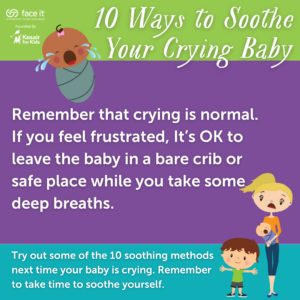
Listening to crying for an extended length of time can be tiresome and overwhelming. It is important to remember that crying for short periods of time cannot hurt your baby, and it is OKAY to take a break. You can safely put your baby in their bare crib for 10 to 15 minutes while you take some time to soothe yourself. Taking deep breaths and listening to music are also ways to relax during this time. If you feel like you need emotional support, you can also call a friend or family member.
A great way to relax during this time is to practice mindfulness. Taking time to be mindful can calm the mind, reduce stress and anxiety, promote relaxation and a sense of inner peace, increase mindfulness, help cultivate a deeper connection between the mind and body, and can be practiced anywhere and at any time, making it accessible for people of all ages and abilities. Light exercise like dancing, stretching, or short walks with the baby can also help reduce tension in your body. Here is a tool with tips for managing stress.
Talking to your Baby’s Caregiver
It can be difficult to leave your child with a new caregiver, but there are tools and tips you can use to support your decision on who to leave your child with. Most importantly, give yourself ample time to find the right caregiver for your family. You can find tips on choosing a safe child care provider or caregiver for your children in this resource and ways to secure background checks and ensure safe caregivers. When leaving your baby with a caregiver, it can be useful to write down specific soothing methods that have calmed your baby in the past. Remember to remind the caregiver that it is okay to take a moment to themselves if they ever become overwhelmed by the crying. And listen to your gut — if you feel uneasy or uncertain about the caregiver’s ability to care for your child, keep looking.
Every year in the United States, there are anywhere from 600 to 1,400 cases of pediatric abusive head trauma, also known as shaken baby syndrome. As a parent, it is important to be able to recognize signs of shaken baby syndrome, especially if you plan to leave your baby with a caregiver. Shaken baby syndrome, also called abusive head trauma, is a result of a baby being forcefully shaken, slammed or thrown. Most often, this type of abuse occurs when a caregiver becomes frustrated because the child won’t stop crying.
More information on shaken baby syndrome can be found using this resource: National Center on Shaken Baby Syndrome – PURPLE Crying
Don’t forget to try out some of the 10 soothing methods next time your baby is crying. And remember to take time to soothe yourself. Please share this information with fellow parents and caregivers!