




18 Jun Kosair for Kids Face It Movement: Safe Medication Storage Keeps Kids Safe
Contact:
Kelsey Dimar
kdimar@kyyouth.org
Kosair for Kids Face It Movement: Safe Medication Storage Keeps Kids Safe
 Louisville, KY – Over one in three of all child fatalities and near fatalities in Kentucky were related to the ingestion of substances, according to the latest Child Fatality and Near Fatality External Review Panel annual report. Of those cases reviewed by the Panel, all overdose/ingestion cases involved a child four years old or younger – emphasizing the vulnerability of our youngest Kentuckians to unsafe access to medications and illicit substances.
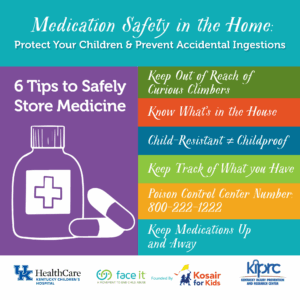
In collaboration with the Kentucky Children’s Hospital (KCH) and Kentucky Injury Prevention and Research Center (KIPRC), the Kosair for Kids Face It Movement offers a free resource, Medication Safety in the Home: Protect Your Children & Prevent Accidental Ingestions, for families and professionals who work with families featuring tips to safely store medicine and prevent tragedies.
The campaign includes a series of video PSAs, a webpage of resources, and a printable flyer featuring these safe medication storage tips:
— Up and Away – Keep prescriptions and over-the-counter medications up and away, in a locked container or medication safe.
— Out of Reach of Curious Climbers – In about half of over-the-counter poisoning cases, the child climbed on a chair, toy, or other object to reach medicine.
— Know What’s in the House – Ask family and guests if they have medication in their purse or luggage so you can put it away safely while at your home.
— Child-Resistant ≠ Childproof – Research suggests about half of accidental poisonings involved child-resistant packaging.
— Keep Track of the number of pills/strips you have in your medication bottle so you can know how many a child may have ingested.
— 800-222-1222 – Program the Poison Control Center number in your phone and keep it posted on your refrigerator.
“These tragedies are easily preventable,” said Barry Dunn, President and CEO of Kosair for Kids, which founded the Face It Movement. “Kosair for Kids is committed to ensuring families have what they need for their children to grow up healthy and safe from harm. That is why we prioritize parent and caregiver education, free tools like lockboxes available to families, and changing simple, everyday habits. We can and must keep harmful substances out of the hands of young children.”
This year, the Face It Bluegrass Team expanded this important resource to highlight opioid overdose prevention and how to use naloxone if ingestion occurs. One of the largest risk factors for overdoses is having a prescription for an opioid in the home, whether that be the child’s or the caregiver’s prescription. CDC guidelines now recommend that households with opioid prescriptions also have Narcan (naloxone) available for use in case of emergencies.
“When taken as directed, there are opioids that can help manage pain and there are opioids that are used to treat and support substance use disorders; however, any opioid that is not taken as directed can have dangerous side effects including overdose. If a suspected overdose occurs, call 911, administer naloxone, and do rescue breathing and chest compressions. Your quick action can save a life – and any opioids in a home stored in a lock bag, out of reach of children will help prevent a tragedy like this from ever happening,” said Dr. Christina Howard, Child Abuse Pediatrician and Chief of Division of Pediatric Forensic Medicine at Kentucky Children’s Hospital.
Less than one in four caregivers report using safe storage practices for medication at home. In emergency department visits for medicine poisonings, parents often say they only turned their back for one minute.
“The Kosair for Kids Face It Movement believes that keeping kids safe is everyone’s responsibility – and that safety starts inside the home. Parents and caregivers work hard every day to provide for, love on, and keep their little ones free from harm. Keeping medications and other substances up and locked away is a key practice to keep everyone in the family safe and healthy,” said Shannon Moody, PhD, representative of the Face It Movement with Kentucky Youth Advocates.
View the Medication Safety in the Home resource and additional information at faceitabuse.org/safemedstorage/. In the event of accidental ingestion of medicine, contact the Poison Control Center Hotline at 800-222-1222 and go to the Emergency Department nearest you.
###
About the Face It® Movement
The Face It® Movement launched in 2013 as an initiative led by Kosair for Kids® in response to the number of child abuse deaths in the Commonwealth. Face It focuses on a three-pronged approach to addressing child abuse and neglect: promote best practices in child abuse prevention and intervention, build awareness and engage the community, and advocate for effective policies to improve the child welfare system. Learn more at faceitmovement.org.
About Kosair for Kids®
Kosair for Kids enhances the health and well-being of children by delivering financial support for healthcare, research, education, social services, and child advocacy. We envision a world in which children in need live life to the fullest. For more information, please visit kosair.org.